

Applications of The Standard Model for Business
A practical framework for understanding, designing and improving organisations as complete systems.
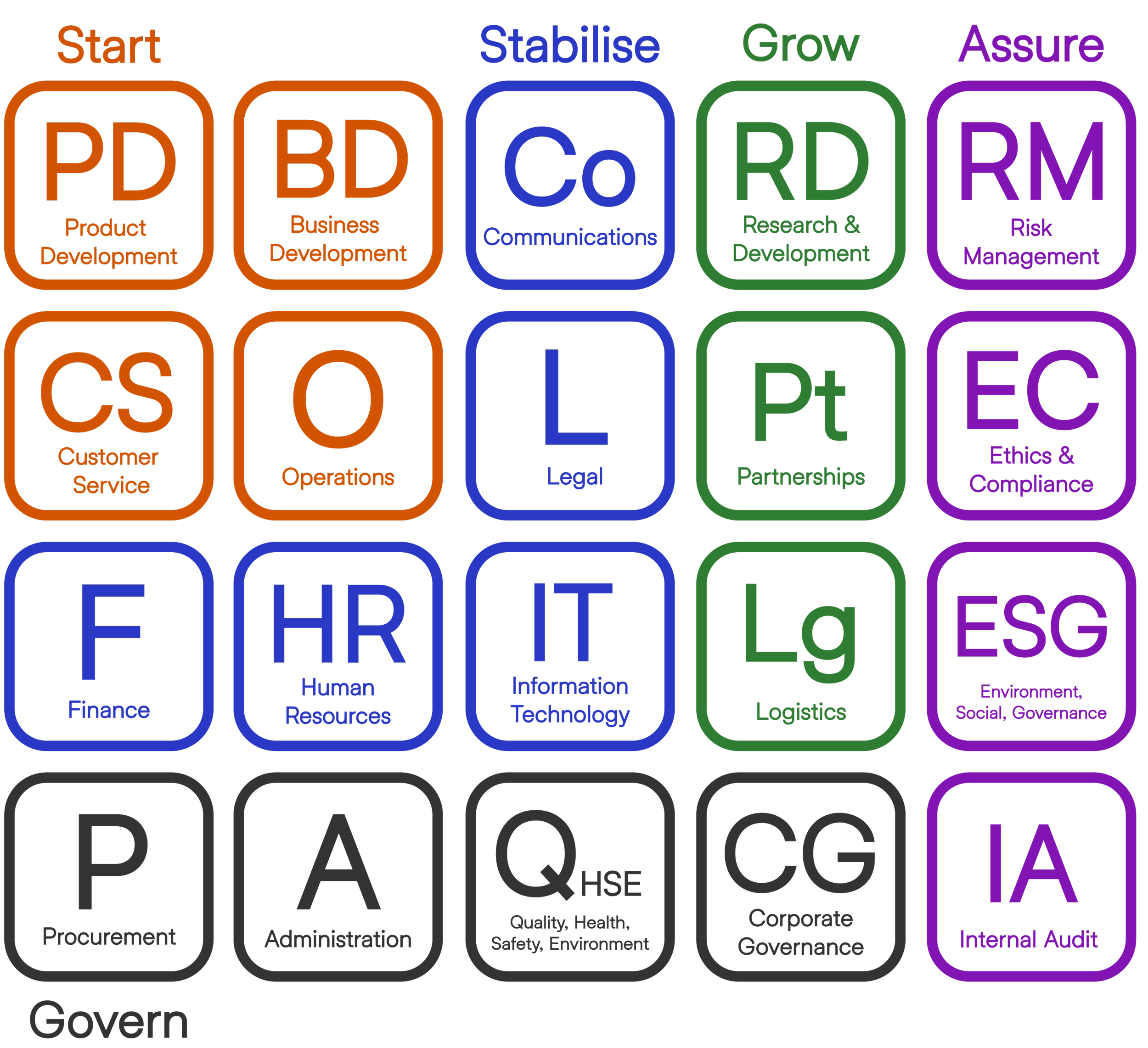
The Model shows how every part of a business connects, helping leaders identify strengths, uncover gaps and make better decisions.
Whether you are building, scaling or leading an organisation, it provides a clear structure for improving performance, alignment and control.
Core applications
The Standard Model for Business can be used to understand, design and improve organisations in six key areas:
1. Strategy and enterprise alignment
Connect strategy with execution.
The Model helps leaders identify the people, processes, systems and capabilities needed to deliver their strategic goals. It reveals where the organisation is not fully aligned with its plans.
2. Organisational design
Build an organisation that can scale.
The Model provides a clear structure for defining roles, responsibilities and capabilities as a business grows. This helps reduce gaps, duplication, confusion and inefficiency.
3. Governance and control
Create clear accountability and effective oversight.
As organisations become more complex, The Model helps leaders design governance structures, decision-making processes and controls that support responsible growth.
4. Risk and assurance
See where the organisation may be exposed.
The Model provides a structured view of risk, control and assurance across the enterprise. It helps leaders strengthen resilience and give stakeholders greater confidence.
5. Executive development
Develop leaders who can see the whole business.
The Model helps professionals move beyond functional expertise and build the broader perspective needed to lead across the enterprise.
6. Investment and due diligence
Understand the business behind the numbers.
Investors, boards and advisors can use the model to assess organisational maturity, identify hidden risks and uncover opportunities for improvement and value creation.
One structure for the whole organisation
The Standard Model for Business provides a consistent way to understand and improve organisations, regardless of their industry, size or location.
It creates a shared language across functions, helping leadership teams discuss the business as one connected system rather than a collection of separate departments.
Built for every industry
Every organisation is different, but the underlying structure of business is remarkably consistent.
The Model can be applied to:
Start-ups and growing businesses
Private and family-owned companies
Large and multinational organisations
Investment portfolios
Public sector and not-for-profit organisations
A technology company may look very different from a manufacturer, bank or healthcare provider. However, each still needs to build, stabilise, grow, govern and assure its operations.
The Model focuses on these shared foundations, making it relevant across industries, sectors and geographies.
Put the model into practice
The Standard Model for Business can be applied through:
Assessments and diagnostics
Training and executive development
Business simulations
Organisational design and transformation
Business and enterprise reviews